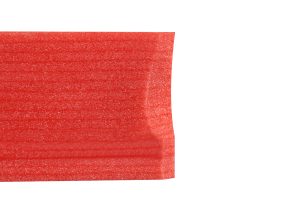
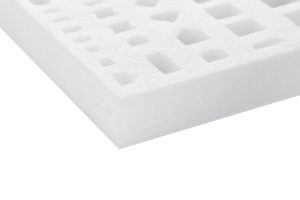
Protective packaging is shaped by more than the thickness of a cushion. Material density, cellular structure, resilience, energy absorption, and recovery behavior all influence how a package responds to drops, vibration, compression, and repeated handling. Understanding material EPP is particularly useful for engineers working with automotive modules, precision instruments, industrial components, and reusable logistics systems because the material’s physical characteristics directly affect packaging geometry and service life. At Proflexpack, we approach these requirements by considering how cushioning materials interact with the product, the packaging configuration, and the logistics environment rather than treating material selection as an isolated decision.
Understanding The Cellular Structure Of EPP
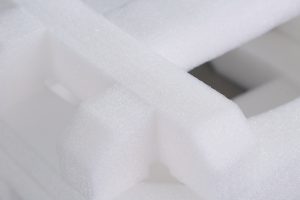
Expanded polypropylene, commonly abbreviated as EPP, is a closed-cell polymer foam produced by expanding polypropylene beads into a lightweight cellular structure. Each cell contributes to the material’s overall mechanical behavior, while the distribution of cells influences density, resilience, and energy absorption. Unlike rigid plastics, the foam structure allows localized deformation when external forces are applied.
Density is one of the most frequently discussed terms in EPP material specifications. It describes the mass of foam relative to its volume and can influence stiffness, compression response, and cushioning behavior. A higher-density formulation is not automatically appropriate for every application; the correct selection depends on product weight, impact conditions, available packaging space, and the degree of support required.
Resilience describes how readily the foam recovers after deformation. That characteristic becomes especially relevant in reusable packaging, where the same protective component may encounter loading and unloading cycles many times. Automotive modules, industrial machinery components, and precision equipment often benefit from packaging concepts that account for both immediate impact absorption and repeated mechanical stress.
Key Mechanical Properties And Their Meaning
Compression strength refers to the resistance of a foam structure against compressive loading. Packaging engineers consider this property when a product may experience stacking pressure, clamping forces, or localized loads during transportation. The objective is to create enough structural support without applying excessive pressure to fragile surfaces.
Impact absorption involves how the cellular structure responds as kinetic energy reaches the package. Material EPP can deform under impact and dissipate part of that energy through its cellular structure. The actual response depends on density, geometry, impact velocity, temperature, and the design of the surrounding packaging system, so material data should always be interpreted within the intended application.
Recovery characteristics are equally relevant to multi-cycle use. After a moderate compression event, resilient foam may regain much of its original form, although repeated loading, environmental exposure, and severe deformation can alter performance over time. For reusable logistics trays, the useful question is not simply how the foam performs during one drop, but how its behavior changes across the expected service cycle.
Why EPP Fits Reusable Protective Systems
Reusable logistics requires a different way of thinking about packaging durability. Instead of evaluating protection solely around a single shipment, engineers must consider repeated insertion, removal, stacking, transportation, cleaning, storage, and handling. This broader lifecycle makes resilient cellular materials particularly interesting for returnable packaging programs.
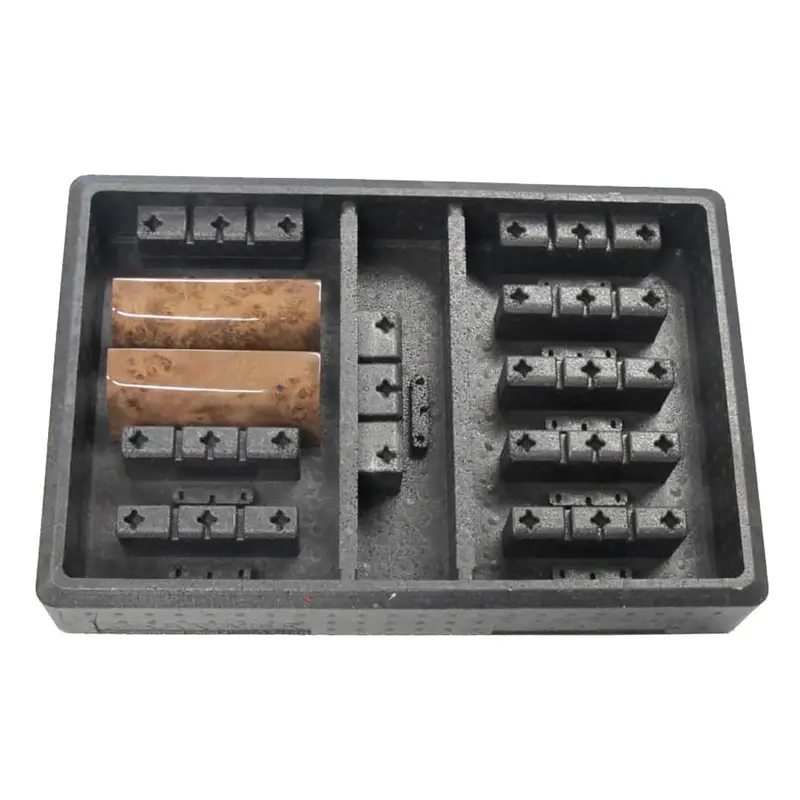
The relationship between product geometry and EPP material is also important. A molded cavity can distribute contact across stronger areas of an automotive component while leaving connectors, switches, optical surfaces, or other sensitive features recessed. Such configurations are useful for equipment ranging from Power Distributors and Computer Chassis to Optical, Measuring, and Testing Instruments.
Environmental conditions deserve attention as well. Temperature fluctuations, mechanical abrasion, storage duration, and exposure to oils or other substances may influence the practical behavior of polymer foam. Packaging specifications should reflect the actual logistics route and operating environment instead of relying exclusively on laboratory values generated under standardized conditions.
EPP In Precision And Industrial Packaging
Small tolerances become significant once packaging is built around precision products. Optical components, electronic assemblies, and molded industrial parts may require carefully positioned cavities that prevent unwanted movement while avoiding concentrated pressure. The foam itself is only one part of the engineering equation; cavity depth, wall thickness, support points, and product orientation all contribute to the final protective performance.
At Proflexpack, we work with EPP foam insert applications covering reusable logistics trays, automotive modules, industrial machinery components, precision equipment, and multi-cycle packaging systems. Our development process includes 3D/CAD design and 72-hour rapid prototyping, while the EPP Foam Inserts | Heavy-Duty Customization program uses Drop & Vibration testing for mass-production evaluation. ISO 9001/14001, UL, ESD compliance, and RoHS and REACH requirements are incorporated into the applicable quality framework.
Industrial packaging also benefits from separating structural support from unnecessary material. For Semiconductor Discrete Devices, Sensors, Power Supplies, and Optoelectronic Equipment, engineers may position support around specific contact zones rather than applying uniform pressure throughout the cavity. Such decisions can make a compact package easier to handle while preserving useful internal clearance.
Conclusion
Understanding EPP terminology gives packaging engineers a clearer basis for making design decisions, especially in applications where cushioning must survive repeated handling without adding unnecessary weight. Density explains one aspect of foam behavior, while resilience, compression response, energy absorption, geometry, and environmental conditions reveal the broader picture.
We at Proflexpack use this engineering perspective when developing reusable protective packaging, combining CAD-based design, rapid prototyping, and testing around the requirements of specific products. With a sound understanding of EPP material properties and the practical role of material EPP in packaging architecture, manufacturers can make more informed choices for electronics, automotive components, precision equipment, and industrial logistics systems.