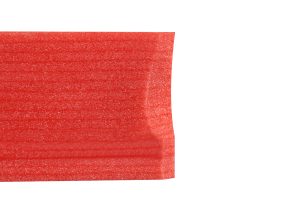
Compression strength is more than a number on a packaging specification. During pallet stacking, warehouse storage, container loading, and road transport, packaging may face continuous downward pressure that gradually changes how forces reach the enclosed product. EPS foam responds through its cellular structure, while corrugated cardboard depends largely on flute configuration, paper strength, box geometry, and environmental conditions. At Proflexpack, we look at these variables together, particularly when packaging is intended for electronics, precision instruments, or other components where internal support matters as much as the outer carton.
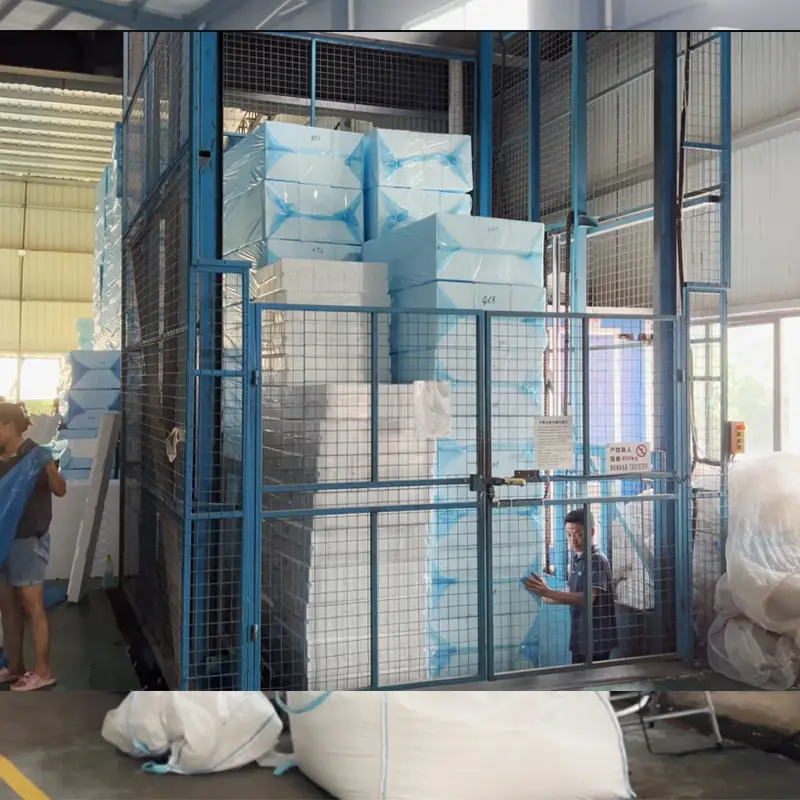
Compression Mechanics Behind Each Material
Corrugated cardboard obtains much of its vertical strength from the fluted medium positioned between liner papers. Box height, flute direction, board grade, edge alignment, and panel dimensions all affect compression performance. A carton with excellent laboratory results may behave differently after exposure to humidity, repeated handling, or prolonged stacking.
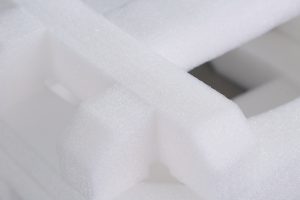
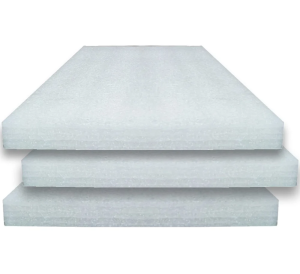
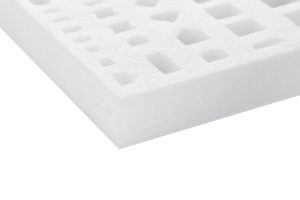
The behavior of EPS foam comes from its fused cellular structure. Under pressure, the cells deform and absorb part of the applied load, while density influences the material’s resistance to compression. This characteristic makes molded foam useful when cushioning and load distribution need to work together rather than relying entirely on the carton walls.
Product geometry introduces another variable. An EPS foam insert creates dedicated support zones around an item, so pressure can be directed toward stronger areas of its housing instead of vulnerable corners or protruding components. Cardboard partitions can provide separation, but they generally offer less opportunity to reproduce complex three-dimensional contours.
Load Distribution Within the Package
A shipping carton primarily protects the product from the surrounding environment, but its internal structure determines how securely the item remains positioned. If an electronic assembly moves inside the package, repeated contact with the carton or adjacent components may create localized stress even though the box itself remains structurally intact.
With an EPS foam insert, engineers can establish cavities, channels, corner supports, and contact surfaces according to the product’s dimensions. Such geometry is useful for Computer Chassis, Power Supplies, Computer Motherboards, and communication equipment in which connectors, ventilation areas, or delicate surfaces may require controlled clearance.
The distinction becomes clearer with irregular products. At Proflexpack, our EPS Anti-Static Foam Inserts | Engineered Export Protection use molded cavities and channels for equipment that requires both physical positioning and ESD considerations. The solution supports applications such as servers, communication machines, laboratory instruments, and consumer electronics, while our 72-hour 3D/CAD prototyping service helps refine geometry before production.
Density, Geometry, and Stacking Conditions
Density should never be considered in isolation. Two foam materials with different densities may react differently under the same load, while cavity dimensions and support locations can substantially change the pressure transferred to a packaged component. Packaging engineers usually examine material behavior alongside the actual product weight and stacking arrangement.
An EPS foam structure can be shaped to accommodate concentrated loads around designated support points. Ribbing, wall thickness, cavity depth, and corner radius all contribute to the way compression travels through the protective geometry. These details become particularly relevant when equipment has uneven weight distribution.
Cardboard performance also depends heavily on configuration. A stronger board does not automatically solve every packaging problem if the carton is oversized, poorly oriented, or exposed to moisture. For products such as Optical, Measuring, and Testing Instruments or Precision Ceramic Products, internal positioning may deserve as much attention as the compression rating of the outer box.
Applications Across Technical Industries
Electronics often contain components with very different mechanical tolerances inside the same enclosure. Semiconductor Discrete Devices, Sensors, Active and Passive Components, and New Power Electronic Components may require stable positioning during storage and distribution, particularly when connectors or exposed interfaces are susceptible to impact.
An EPS foam insert can also be configured around optical and communication equipment. Single-Mode Fiber Optic Equipment, Optoelectronic Equipment, Optical Disc Drives, and Data Communication Multimedia Systems may involve delicate assemblies whose protection depends on cavity accuracy rather than simply increasing the amount of cushioning material.
Medical packaging presents similar engineering questions. Packaging design for medical devices may involve diagnostic instruments, Class II Medical Devices, or Class III Medical Devices, with requirements extending beyond compression performance. Cleanliness, dimensional control, vibration exposure, documentation, and handling conditions may all influence the appropriate internal packaging concept.
Conclusion
Compression strength tells only part of the packaging story. Corrugated cardboard remains practical for many distribution tasks, particularly where products are standardized and relatively tolerant of external loading. An EPS foam insert, by contrast, offers a molded support structure that can be adapted to the shape, weight distribution, and vulnerable areas of a specific component.
For electronics, optical equipment, laboratory instruments, and delicate industrial assemblies, internal load paths deserve careful evaluation alongside carton strength. At Proflexpack, we use product geometry, 3D/CAD development, and application requirements to shape packaging concepts around real handling conditions. The more demanding the product, the more valuable it becomes to assess not just how much compression a package withstands, but where that force ultimately reaches the item inside.